

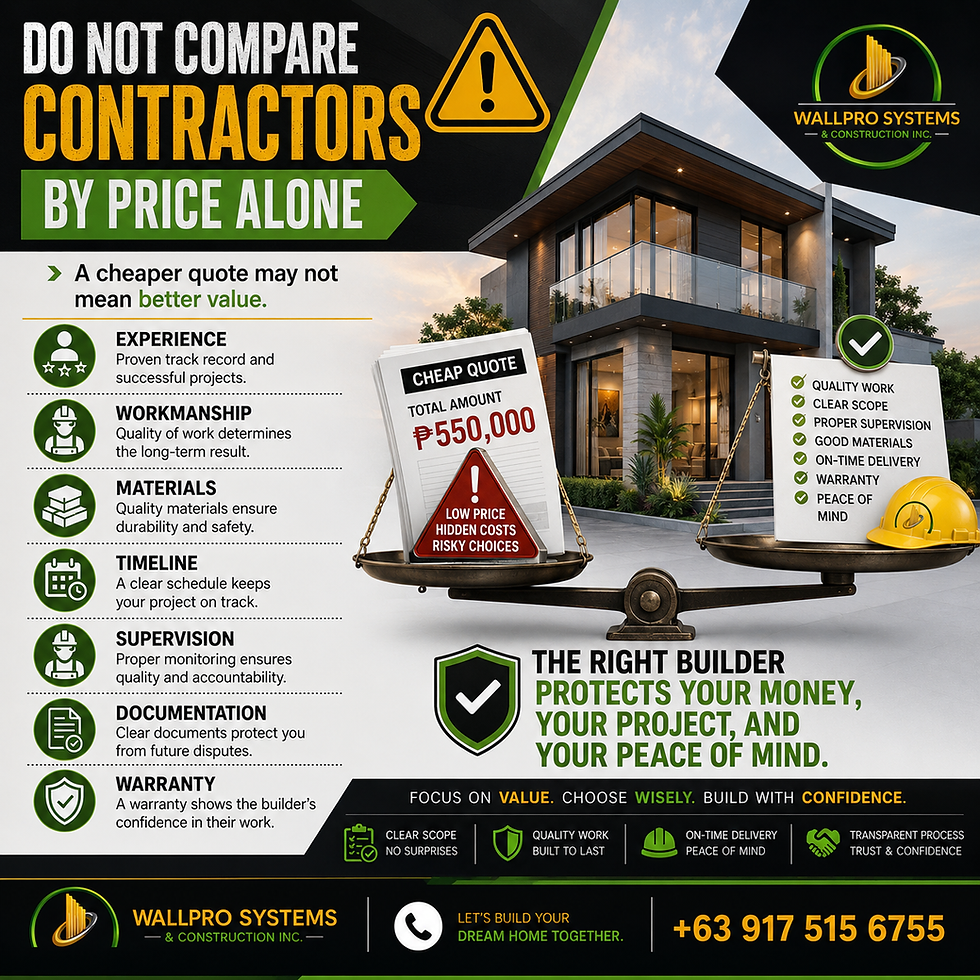
Do Not Compare Contractors by Price Alone: What Homeowners Should Check

When homeowners receive several construction quotations, the first number they usually compare is the total contract price.
One contractor may quote ₱2.8 million.
Another may quote ₱3.2 million.
A third may quote ₱3.6 million.
The ₱2.8 million proposal may immediately appear to be the best choice.
But are the contractors offering the same house, materials, construction system, supervision, documentation, warranty, and after-sales support?
Possibly not.
A lower quotation may represent excellent value when the contractor is efficient, properly organized, and supported by reliable suppliers.
However, it may also be lower because important items have been reduced, excluded, assumed, or left undefined.
The cheapest quotation can become expensive when the homeowner later pays for:
Missing scope
Material upgrades
Design corrections
Additional site work
Delays
Rework
Drainage improvements
Waterproofing repairs
Permit requirements
Unfinished work
Construction defects
Weak warranty support
Do not compare contractors by price alone.
Compare what each contractor is actually promising to deliver—and how the company will remain accountable from planning to turnover.
A Construction Quotation Is More Than a Total Amount
A construction quotation should explain what is included behind the price.
Two contractors may quote the same floor area but calculate very different project scopes.
One proposal may include:
Complete structural works
Standard tiles
Aluminum windows
Electrical and plumbing fixtures
Kitchen cabinets
Exterior drainage
Permit assistance
Testing
Punch listing
Written warranty
Another may include only:
Basic structural shell
Limited electrical points
Limited plumbing fixtures
No cabinets
No site drainage
No permit costs
No testing
No written warranty
The second quotation may look cheaper because the homeowner will need to pay for many items separately.
The correct comparison is not:
Which contractor has the lowest price?
The correct comparison is:
Which contractor offers the best complete value for the required project?
1. Compare the Scope of Work
The scope of work is the first and most important part of a contractor comparison.
It should explain exactly what the contractor will provide.
Check Whether the Quotation Includes:
Site clearing
Temporary facilities
Layout and surveying
Excavation
Foundation
Structural framing
Walls
Roofing
Doors and windows
Ceiling
Floor and wall finishes
Painting
Electrical system
Plumbing system
Sanitary system
Waterproofing
Kitchen cabinets
Built-in storage
Exterior works
Driveway
Drainage
Fence and gate
Testing
Final cleaning
Punch listing
Warranty
Do not assume that the phrase “complete house” includes everything required for occupancy.
Ask every contractor to provide a written list of:
Inclusions
Exclusions
Owner-supplied items
Provisional items
Allowances
Optional work
A low quotation may simply contain a smaller scope.
2. Compare Material Specifications
A quotation that states only “standard materials” is difficult to evaluate.
Standard can mean different things to different contractors.
Material specifications should identify, where applicable:
Brand
Product type
Size
Thickness
Grade
Color category
Performance requirement
Approved equivalent
Examples of Specifications to Compare
Roofing
Check:
Material type
Profile
Thickness
Coating
Flashing
Insulation
Gutter and downspout system
Tiles
Check:
Size
Price allowance
Type
Finish
Slip resistance
Installation method
Grout
Windows
Check:
Frame material
Frame thickness
Glass thickness
Hardware
Screen
Sealant
Window type
Doors
Check:
Door material
Frame
Hardware
Lockset
Finish
Moisture suitability
Paint
Check:
Brand or approved equivalent
Surface preparation
Primer
Number of coats
Interior or exterior system
Waterproof or elastomeric coating, when required
Electrical Works
Check:
Wire type and size
Breaker brand and capacity
Number of outlets
Lighting points
Dedicated appliance circuits
Grounding
Panelboard
Fixtures included
Plumbing Works
Check:
Pipe type
Pipe size
Fixture allowance
Valves
Water tank
Pump
Drainage
Sanitary connections
Two houses may look similar at turnover but perform differently because of the materials installed behind the visible finishes.
3. Compare the Bill of Quantities
A detailed Bill of Quantities, or BOQ, helps the homeowner understand how the project cost is organized.
It may show:
Work categories
Quantities
Units
Labor
Materials
Equipment
Unit costs
Total costs
A BOQ helps with:
Comparing quotations
Understanding the budget
Evaluating progress billings
Managing variations
Identifying missing work
Reviewing deductions
A lump-sum contract can still be valid and practical, but the supporting scope and specifications must be clear.
Be cautious when a quotation contains only:
Construction of two-storey house — ₱3,000,000
That amount does not explain what the homeowner will receive.
4. Compare the Design Basis
Before comparing prices, confirm whether every contractor is pricing the same approved plans.
One contractor may quote based on:
Complete architectural plans
Structural plans
Electrical plans
Plumbing plans
Material specifications
Another may quote based only on:
Floor plan
Perspective
Sketch
Approximate floor area
Verbal description
These quotations are not directly comparable.
A contractor pricing incomplete plans must make assumptions.
Those assumptions may later become:
Additional work
Design revisions
Material upgrades
Variations
Cost disputes
The more complete the plans and specifications, the more meaningful the price comparison becomes.
5. Compare Contractor Experience
A low price cannot replace relevant construction experience.
Ask whether the contractor has completed projects similar in:
Size
Design
Number of storeys
Site condition
Structural system
Finish level
Location
Budget
Construction method
A contractor experienced in small renovations may not automatically be prepared for a complex two-storey residence on a sloping lot.
Request Evidence
Ask for:
Completed-project photographs
Current projects
Client references
Project addresses, when permitted
Before-and-after documentation
Turnover records
Warranty-repair history
Do not evaluate experience only through attractive social-media photos.
Ask about the company’s role in each project.
Was it the:
Main contractor?
Subcontractor?
Designer?
Supplier?
Project manager?
Labor-only provider?
6. Verify Contractor Legitimacy
Before paying a deposit, verify the contractor’s business and professional credentials.
Review:
Legal business name
Business registration
Contractor’s license appropriate to the work
Tax and invoicing details
Office address
Authorized representative
Professional partners
Written contract
Official payment process
Be cautious when:
The quotation uses only an individual nickname
Payments are requested through unrelated accounts
No office address is provided
The company name changes between documents
No authorized signatory is identified
Receipts are unavailable
The contractor refuses written agreements
A properly documented contractor relationship provides stronger accountability.
7. Compare Site Supervision
Good materials can still fail when installed incorrectly.
Ask who will supervise the project.
Possible roles include:
Project manager
Project engineer
Architect
Foreman
Safety officer
Quality-control personnel
Ask These Questions
Who will be assigned to the site?
How often will the project manager visit?
Who approves completed work?
Who checks subcontractors?
Who coordinates design clarifications?
Who reports progress to the owner?
Who handles defects?
Who has authority to approve changes?
A quotation may be lower because the contractor has included minimal supervision.
Poor supervision can result in:
Incorrect dimensions
Material waste
Rework
Construction defects
Delays
Safety concerns
Unauthorized substitutions
8. Compare the Construction Timeline
A very short timeline may sound attractive, but it should be realistic.
Ask the contractor to provide a schedule showing major stages such as:
Site preparation
Foundation
Structural works
Wall installation
Roofing
Electrical and plumbing rough-ins
Plastering and ceiling
Waterproofing
Tile installation
Doors and windows
Cabinets
Painting
Exterior works
Testing
Punch listing
Turnover
Evaluate Whether the Timeline Allows For:
Permit processing
Material procurement
Concrete curing
Waterproofing testing
Owner selections
Inspections
Rain interruptions
Punch-list corrections
Fast construction can be valuable when achieved through good planning, efficient systems, prefabrication, and proper coordination.
It becomes risky when speed is achieved by skipping:
Curing
Testing
Inspections
Surface preparation
Quality checks
9. Compare Payment Terms
Do not select a contractor solely because the down payment is low—or because the company promises easy payment terms.
Review how payments are connected to actual work.
A Better Payment Schedule May Include:
Mobilization
Foundation completion
Structural milestone
Roofing completion
Rough-in completion
Finishing milestone
Substantial completion
Final completion
Retention, when agreed
Payments should generally correspond with verified accomplishments under the contract.
Be cautious when the contractor requests:
Very large advance payment
Full material payment without delivery records
Calendar-based payments unrelated to progress
Final payment before punch listing
Cash payments without receipts
Verbal payment changes
Clear payment conditions protect both the contractor and homeowner.
10. Compare the Change-Order Process
Changes are common in construction.
The owner may request:
Additional room
Different tile
Larger window
More electrical outlets
Cabinet upgrade
Roof modification
Additional drainage
The site may also reveal unexpected conditions.
Every contractor should explain how variations will be handled.
A proper variation order should identify:
Description of the change
Reason
Added or deducted cost
Material effect
Timeline effect
Approval
Date
A low quotation can grow quickly when every unclear item becomes an additional charge.
Ask:
What conditions can increase the contract price?
11. Compare Quality-Control Procedures
Do not ask only how fast the contractor can build.
Ask how the company verifies quality.
Important inspections may include:
Site layout
Excavation
Reinforcement
Formwork
Concrete placement
Wall alignment
Electrical conduits
Plumbing pipes
Waterproofing
Roofing
Tiles
Doors and windows
Drainage
Final systems testing
Ask for Documentation
A contractor may provide:
Inspection checklists
Test records
Dated photographs
Progress reports
Corrective-action records
Punch-list reports
Quality should be checked before work is concealed.
Correcting a plumbing line before plastering is easier than opening a completed wall.
12. Compare Project Communication
Poor communication can turn a good design and reasonable price into a stressful project.
Ask how often the contractor will provide updates.
A proper project update may include:
Work completed
Work in progress
Upcoming activities
Materials delivered
Quality checks
Site concerns
Delay status
Owner decisions required
Progress photographs
Confirm:
Official contact person
Reporting schedule
Approval procedure
Emergency contact
Meeting frequency
Recordkeeping method
The cheapest contractor may become expensive when important decisions are communicated late or not documented.
13. Compare Permit Responsibilities
Permit and regulatory responsibilities should be discussed before signing.
Clarify who will handle or coordinate:
Technical plans
Professional signatures
Building-permit application
Zoning or locational requirements
Subdivision or homeowners’ association clearance
Electrical requirements
Occupancy-related documents
Plan revisions
Ask whether the quotation includes:
Professional fees
Permit fees
Printing
Processing
Inspection coordination
Revisions
A lower quotation may exclude all permit-related costs.
14. Compare Site-Development Inclusions
Site development is one of the most commonly underestimated parts of construction.
Check whether each quotation includes:
Clearing
Excavation
Filling
Soil compaction
Hauling
Temporary access
Retaining structures
Slope protection
Drainage
Catch basins
Driveway
Utility trenching
Fencing
A house quotation may cover only the structure.
The owner may later discover that preparing the lot requires a significant separate budget.
This is especially important when the property is:
Sloping
Lower than the road
Difficult to access
Filled with weak soil
Exposed to runoff
Located far from utilities
15. Compare Warranty Terms
A verbal warranty is not enough.
Ask every contractor to provide written warranty terms showing:
Warranty period
Start date
Expiration date
Covered workmanship
Exclusions
Claim procedure
Official contact
Inspection process
Repair responsibility
Response timeline
Ask specifically whether the warranty addresses:
Roofing
Waterproofing
Plumbing
Electrical work
Tiles
Doors and windows
Cabinets
Drainage
Paint and finishes
A cheap contractor with no meaningful warranty can create a costly after-sales problem.
16. Compare After-Sales Support
A contractor’s responsibility should not disappear immediately after final payment.
Ask previous clients:
Did defects appear after turnover?
Did the contractor respond?
How long did the response take?
Was the cause properly identified?
Was the repair completed?
Did the defect return?
Was the contractor still reachable?
A beautiful completed-project photograph does not show how the contractor handled a roof leak three months later.
After-sales performance is one of the strongest indicators of accountability.
17. Compare Safety and Site Management
Construction safety affects:
Workers
Owners
Neighbors
Visitors
Property
Schedule
Ask how the contractor manages:
Personal protective equipment
Temporary electrical lines
Scaffolding
Excavations
Housekeeping
Material storage
Waste
Site access
Emergency procedures
Poor site management may result in:
Accidents
Property damage
Delays
Material loss
Neighbor complaints
Safety and housekeeping require resources and supervision.
A lower quotation may omit these operational costs.
18. Compare the People Behind the Proposal
A company’s quotation is only as reliable as the team responsible for delivering it.
Know who will handle:
Design
Engineering
Estimating
Procurement
Site management
Quality control
Billing
Warranty claims
Ask whether the same people who made the promises during the sales meeting will remain involved during construction.
Be cautious when the proposal depends entirely on one person with no visible support system.
19. Compare Financial Stability and Project Capacity
A contractor may offer a low price to secure a project quickly.
But can the company sustain the work?
Possible warning signs include:
Workers frequently unpaid
Materials purchased only after owner advances
Several delayed projects
Frequent requests for early billing
Suppliers refusing delivery
Project funds used for unrelated work
Sudden staff changes
Contractor cash-flow problems can cause:
Work stoppage
Material delays
Lower-quality substitutions
Abandoned projects
Unfinished warranty obligations
The homeowner does not need confidential financial statements for every small project, but should look for evidence of organization, capacity, and stable operations.
20. Compare the Total Cost of Ownership
The construction price is only the initial cost.
The long-term cost of a house may include:
Maintenance
Repairs
Energy consumption
Water leakage
Repainting
Roof replacement
Drainage correction
Termite treatment
Cabinet replacement
Electrical upgrades
A higher-quality material or installation may cost more initially but reduce future repairs.
A cheap system that requires frequent maintenance may become more expensive over time.
Why the Cheapest Quotation May Be Cheaper
A quotation may be lower because of legitimate advantages such as:
Efficient project management
Faster wall systems
Strong supplier relationships
Reduced material waste
Standardized details
Skilled crews
Accurate planning
Modern construction technology
It may also be lower because of:
Missing scope
Reduced quantities
Lower-grade materials
Minimal supervision
Unpriced site conditions
Unrealistic labor cost
No warranty allowance
Incomplete plans
Unrecorded exclusions
Do not reject a low quotation automatically.
Ask the contractor to explain how the price was achieved.
Contractor Comparison Table
Comparison Area | Contractor A | Contractor B | Contractor C |
Total price | |||
Floor area | |||
Finish level | |||
Detailed scope | |||
Material specifications | |||
BOQ provided | |||
Site development | |||
Permits included | |||
Cabinets included | |||
Drainage included | |||
Project duration | |||
Site supervision | |||
Progress reporting | |||
Testing | |||
Punch-list process | |||
Written warranty | |||
After-sales service | |||
Payment terms | |||
Client references | |||
Overall value |
Red Flags in a Cheap Construction Quotation
Be cautious when the contractor:
Provides only a one-page total amount
Uses vague terms such as “complete finish”
Cannot identify material specifications
Prices the project without inspecting the lot
Has not reviewed the approved plans
Excludes drainage without explanation
Gives an unrealistic timeline
Requires a very large advance
Refuses written variation orders
Provides only a verbal warranty
Cannot identify the site supervisor
Has no permanent office or official payment process
Cannot provide recent client references
Promises that no defects will appear
Pressures the owner to sign immediately
Questions to Ask Every Contractor
Before selecting a contractor, ask:
What exactly is included in your price?
What is excluded?
Which items must the owner supply?
Are the plans complete enough for final pricing?
What material brands, sizes, and specifications are included?
Is site development included?
Are drainage works included?
Are permits and professional fees included?
Who will supervise the site?
How often will progress updates be provided?
What inspections and tests will be completed?
How are progress billings verified?
How are variations approved?
What happens when material prices change?
What is the construction timeline?
What could extend the timeline?
Is punch listing included?
What written warranty will be issued?
Who handles warranty claims?
Can you provide previous clients who experienced after-sales service?
How to Choose the Best Contractor
The best contractor is not necessarily:
The cheapest
The most expensive
The fastest
The most popular online
The contractor with the most attractive perspective
The best contractor is the one that provides the strongest combination of:
Clear scope
Appropriate price
Qualified team
Suitable materials
Realistic timeline
Organized supervision
Transparent communication
Written documentation
Quality-control procedures
Warranty
After-sales accountability
Frequently Asked Questions
Should I automatically reject the cheapest contractor?
No. A low price may be legitimate. Review the scope, specifications, capacity, timeline, documentation, and warranty before deciding.
Why are contractor quotations so different?
The contractors may be using different scopes, materials, assumptions, labor rates, construction systems, overheads, timelines, and risk allowances.
Is the most expensive contractor always the best?
No. A high price does not automatically guarantee quality. The proposal must still be evaluated carefully.
What is the most important document when comparing quotations?
The approved plans, detailed scope, specifications, and BOQ provide the strongest basis for comparison.
Can I compare contractors using price per square meter?
Price per square meter can provide an initial reference, but it does not explain design complexity, site conditions, materials, inclusions, or finish level.
Should warranty affect contractor selection?
Yes. A clear written warranty and reliable after-sales process are important parts of the contractor’s total value.
Is site inspection necessary before final quotation?
Yes. Access, slope, soil, drainage, clearing, utilities, and neighboring conditions can affect cost.
Should I ask for previous clients?
Yes. Ask about construction performance, communication, billing, defects, turnover, and warranty response.
Final Advice for Homeowners
Do not select a contractor based only on the lowest figure at the bottom of the quotation.
Compare:
Scope of work
Material specifications
Bill of Quantities
Plans and design basis
Experience
Legitimacy
Site supervision
Construction schedule
Payment terms
Variation process
Quality inspections
Communication
Permit responsibilities
Site development
Warranty
After-sales service
The real construction cost is not only the amount you pay to build.
It also includes:
Missing scope + variations + delays + rework + defect repairs + maintenance + after-sales risk.
A contractor offering a higher initial price may provide better value when the proposal includes stronger materials, clearer documentation, better supervision, complete testing, reliable turnover, and responsive warranty support.
Choose the contractor who can clearly answer:
What will you build?
What materials will you use?
How will you inspect the work?
How will you document progress?
What happens when something changes?
Who remains responsible after turnover?
Price matters.
But clarity, quality, accountability, and long-term value matter more.
Build With Clarity Through WallPro Systems & Construction
Planning to build or renovate in Cagayan de Oro?
WallPro Systems & Construction supports a documented design-and-build process that may include:
Site inspection
Architectural and engineering coordination
Detailed scope of work
Material specifications
Construction cost planning
Project scheduling
Progress documentation
Quality inspections
Testing
Punch listing
Turnover
Limited written warranty
After-sales coordination
Before comparing quotations, prepare:
Lot documents
Survey or lot plan
Approved plans
Required floor area
Room requirements
Preferred finish level
Target budget
Site photographs
Desired construction schedule
Message “COMPARE QUOTES” to request guidance on evaluating contractor proposals beyond the total price.
#WallProSystems #WallProCDO #ContractorComparison #ConstructionQuotation #HouseConstructionCDO #TrustedContractorCDO #HomeBuilderCDO #DesignBuildCDO #BuildWithClarity


Comments