top of page

Are you paying for actual construction progress, or just paying because the contractor asked? That is one of the biggest risks homeowners face. In many CDO projects, budget problems do not start because the total contract price is wrong. They start because the payment structure is weak. Current local CDO guidance explains that milestone payments and progress billing are meant to release money only after a defined stage of work is completed and verified, not through loose “as needed” requests.


A practical progress payment guide in Cagayan de Oro starts with one simple rule: tie payment to deliverables, not promises. Recent local guidance recommends a fixed-scope contract with clear inclusions and exclusions, work timeline with milestones, progress billing tied to completed work, and a written change-order process. One current CDO article even gives a sample structure where mobilization is smaller, then payments move by stage such as foundation, structural walls/columns/beams, roofing and weather-tight stage, MEP rough-ins, plastering/ceilings/waterproofing, and later finishing milestones.


Documentation matters just as much as the schedule. Local CDO guidance says homeowners should require photos, videos, progress reports, and milestone tracking so payment is based on visible progress, delivered materials, and completed stages. That is especially important for busy owners or OFWs who are not always on site. Before releasing a payment, inspect the work or require documented proof that the stage is complete. The final release should come only after punchlist and turnover checks are done.


The smartest solution is simple: use milestone-based progress payments, require documented updates, and approve changes only in writing. That keeps your budget under control and makes the project easier to manage from start to turnover.


Planning to build in CDO? Message WallPro CDO today for a guided contract and progress-payment review, clearer milestones, and smarter construction start.




How do you know if a contractor in CDO is truly reliable, or just good at making a quote look attractive? That is where many homeowners make the wrong decision. They compare price first, then discover later that the real problem was not the number. It was the missing detail behind it. Current local CDO guidance says a smart hiring process starts before you sign anything: define your total budget, secure your lot documents, decide your house type, create a needs-vs-wants list, and avoid asking for final pricing before the site and scope are clear.


The first thing to check is whether the builder does a proper site visit before quoting. Local CDO guidance says a real site assessment should look at legal readiness, access and logistics, utilities, drainage, topography, and risk items like soil or siteworks. A quote based only on assumptions can miss major real-world costs. After that, ask for a detailed BOQ or cost breakdown, plus a written inclusions and exclusions list. This matters because hidden siteworks, drainage fixes, and temporary utilities are common budget traps in CDO builds.


You should also screen for red flags. Current local guidance warns against contractors who cannot show proper licensing or insurance, refuse to sign a written contract, give vague estimates, or ask for large upfront payments. One CDO guide says more than 30% upfront is a major warning sign. A safer setup is a clear contract with milestone-based payments, written materials or allowances, timeline, and variation-order rules.


The smartest solution is simple: choose the builder who gives you the clearest system, not just the lowest quote. Good hiring decisions start with documentation, transparency, and real site-based pricing.


Planning to build in CDO? Message WallPro CDO today for a guided contractor-check review, clearer quote direction, and smarter construction start.


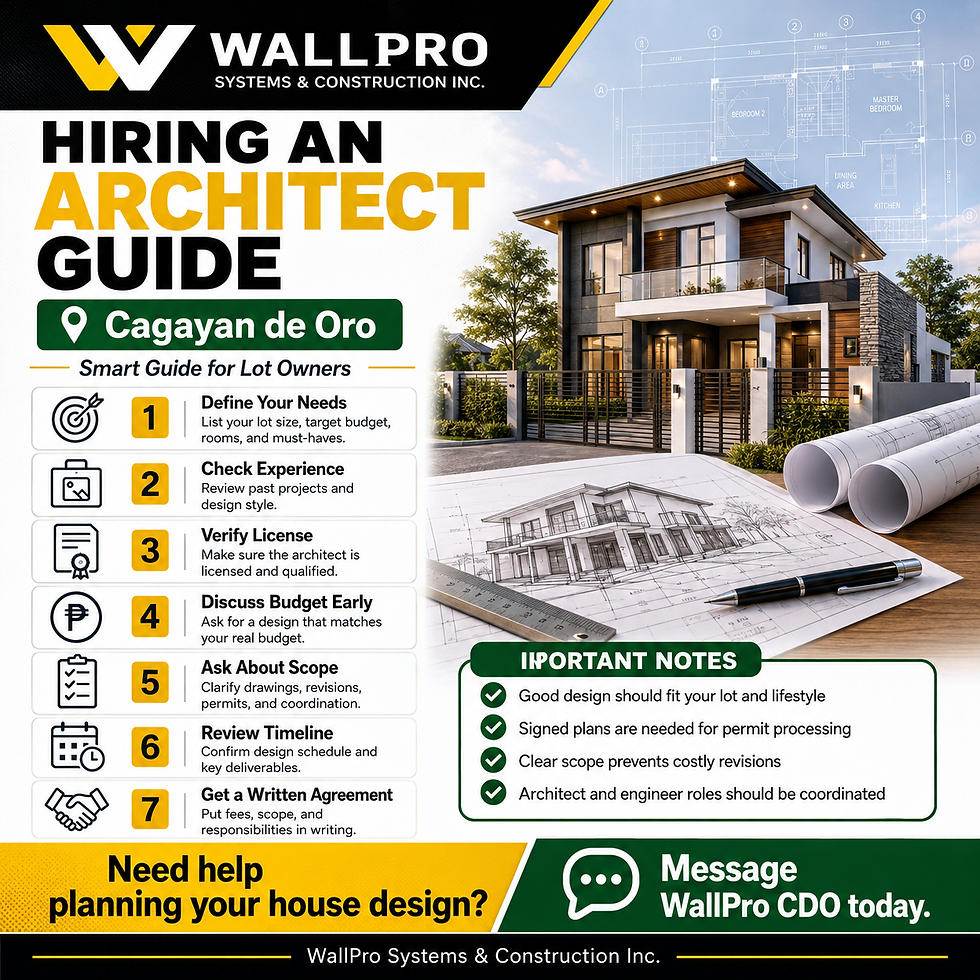
Do you really need an architect before building your house in CDO, or can you skip that step and go straight to construction? That is one of the biggest mistakes lot owners make. Many people ask for estimates too early or rely on rough sketches, then get stuck when the design does not fit the lot, the budget, or the permit process. Current local CDO guidance is clear: an architect handles the floor plans, elevations, sections, site development plan, and architectural details, while also helping ensure the design meets setbacks, ventilation, lighting, and functional layout requirements. Without properly signed and sealed architectural documents, permit applications can be rejected.


A practical hiring an architect guide in Cagayan de Oro starts with choosing someone who can do more than draw a beautiful house. You need an architect who can align the design with your lot size, lifestyle, budget, and local code requirements. Local CDO guides recommend hiring an architect early for overall design leadership, then involving the structural engineer and other technical professionals as the plan develops. That coordination matters because the building permit process requires plans and specifications signed and sealed by the corresponding licensed design professionals.


An architect also helps protect your budget. Current local CDO budget guidance says the safest way to estimate total house cost is to combine construction cost with outside costs like permits, design, utilities, and siteworks, plus contingency. That means good design is not just about appearance. It is also about avoiding costly revisions, weak space planning, and permit delays later.


The smartest solution is simple: hire an architect early, define your must-haves clearly, and turn your ideas into a buildable, permit-ready plan before asking for final construction pricing.


Planning to build in CDO? Message WallPro CDO today for a guided design review, clearer next steps, and a smarter start with the right architect-led process.


Wallpro System & Construction Inc | All Rights Reserved.
Cagayan de Oro
bottom of page