

Occupancy Permit Guide in Cagayan de Oro

Is your house already finished, but you are still unsure what makes it legally ready for use? That is where many homeowners get confused. In Cagayan de Oro, the final step after construction is the Certificate of Occupancy, and the city’s official OBO resources provide a dedicated page, a checklist PDF, and a unified application form for it. Local guidance also notes that an occupancy permit is required before a newly constructed or renovated structure can be legally used or occupied.
A practical occupancy permit guide in Cagayan de Oro starts with the right forms. The city provides a Unified Application Form for Certificate of Occupancy and Fire Safety Inspection Certificate, which ties the OBO process to fire-safety compliance. The official CDO checklist for Certificate of Occupancy applications also identifies it as the documentary requirements list for single dwelling residential, commercial, industrial, and other building types, so homeowners should use the checklist that matches their actual project.
The next step is documentary completeness. The official checklist states that the application begins with a filled-up Unified Application Form for Certificate of Occupancy, and local permit guidance adds that the OBO will look for compliance with the previously issued building and trade permits, plus proof that the structure was completed according to approved plans and specifications. This means occupancy permit approval is not just about finishing the house visually. It is about proving that the completed work matches what was legally approved.
Timing matters too. Current local guidance says occupancy permit processing commonly happens after final inspection, and one local CDO guide places the processing window at around 5–10 days, assuming the application and inspections are complete. Fee references vary, but local CDO-based guidance often places residential occupancy permit costs in the rough range of ₱1,000–₱5,000, while another local article mentions a typical ₱6,000–₱8,000 residential estimate depending on project scale. Those numbers should be treated as planning references only, since actual totals can change with scope and OBO assessment.
The smartest solution is simple: do not wait until the house is fully finished before checking occupancy requirements. Keep your approved plans, permit records, and inspection-related documents organized from the start, then review the official OBO checklist before filing. For the most current requirements or follow-up, the city lists the Office of the Building Official contact numbers and office details on the official city website.
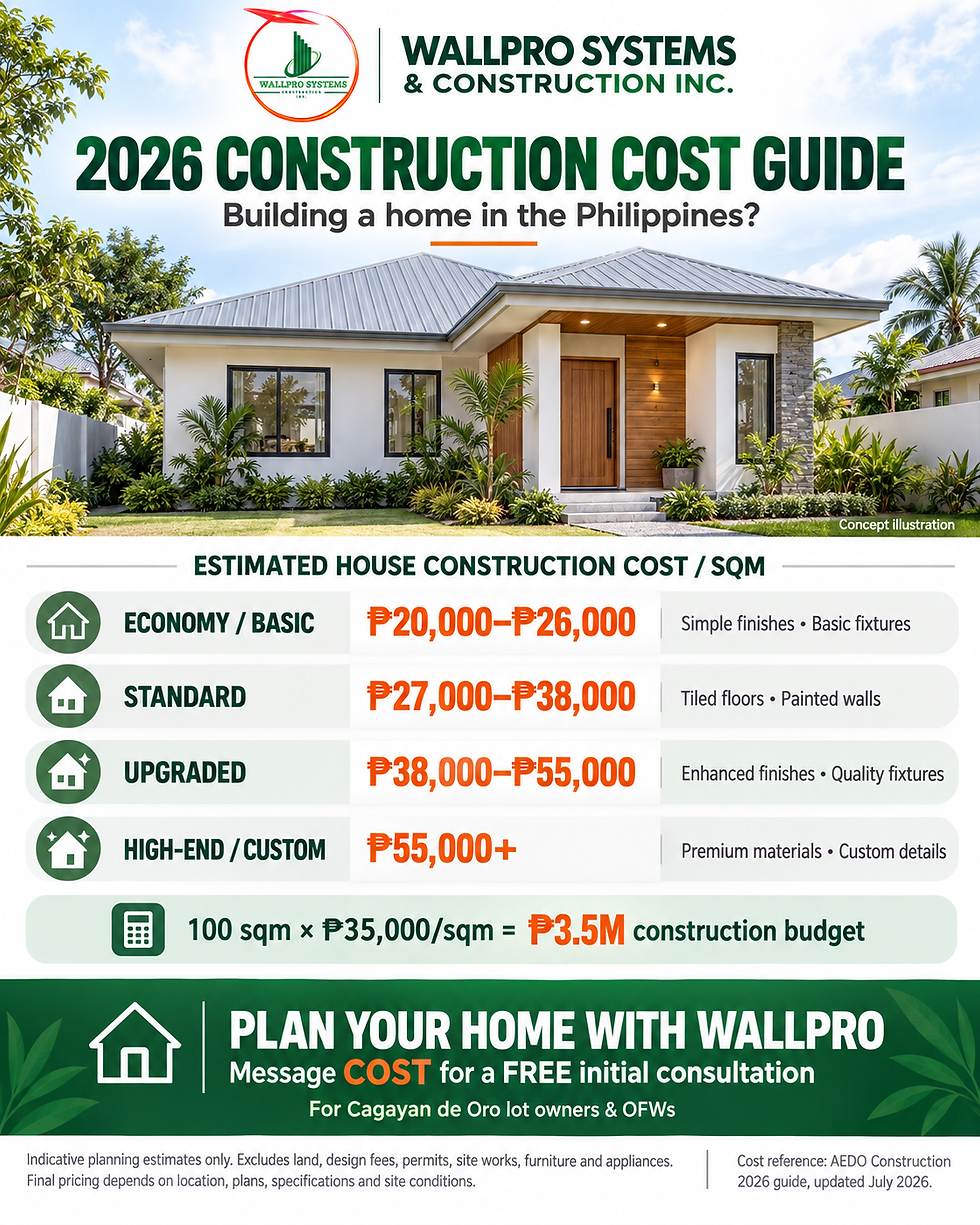
Planning to build or finish a house in CDO? Message WallPro CDO today for a guided permit-readiness check, clearer next steps, and a smarter construction start.


Comments